
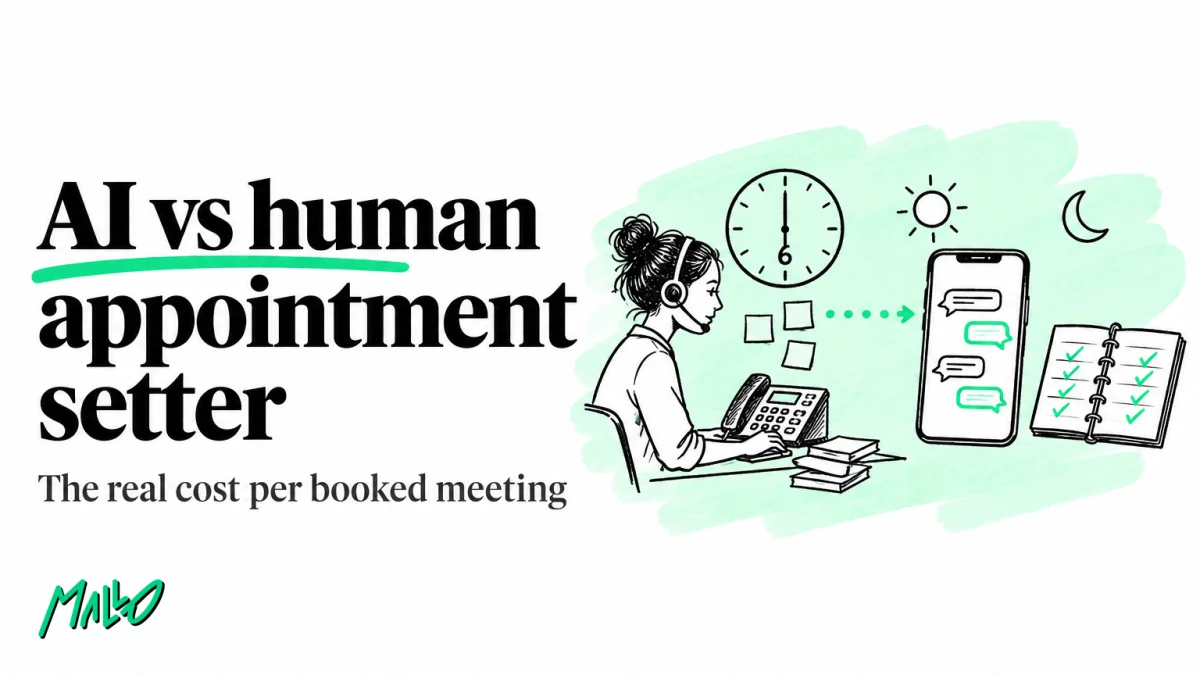
Comparing an AI appointment setter vs a human one usually starts with the wrong numbers: an hourly rate on one side, a monthly plan on the other. Neither tells you what a booked meeting really costs, or how many leads slip through while nobody answers.
This guide builds the full cost of a human setter from sourced US and UK pay data, sets out what an AI setter really costs, and compares what matters beyond price: response time, coverage and consistency. It ends with the hybrid model most sales teams adopt.
Quick verdict by lead volume
| Your situation | What weighs most | Our recommendation |
|---|---|---|
| Under 50 leads a month | A salary is hard to justify on so few leads | An AI setter first, your salespeople on the meetings |
| 50 to 300 leads a month | First-reply time and follow-ups that slip | An AI setter on qualification and follow-up, one rep on hot leads |
| Over 300 leads a month | Scaling up and staying consistent every month | An AI setter on all inbound volume, your team on negotiation |
AI appointment setter vs human setter: what is the difference?
Both do the same job: turn a new lead into a qualified meeting for a salesperson. The difference is how the job is done, and how far it scales.
The human appointment setter
A human setter calls or messages new leads, asks qualifying questions and books meetings for closers. The role is common in coaching, insurance, solar and real estate, where a salesperson’s time is too valuable to spend on first calls. A good setter builds rapport quickly, but works set hours and handles one conversation at a time.
The AI appointment setter
An AI appointment setter is software that holds the same conversation in writing or by voice: it replies to each lead, asks your questions in natural language, books the meeting in the calendar and hands over to a human when needed. Our AI appointment setter page shows what that looks like for a closing team.
A setter, human or AI, is paid to book meetings that happen, not to make calls.
How much does a human appointment setter cost in 2026?
A human appointment setter costs an hourly rate or salary, plus commission, plus everything an employer pays around the job. Start with the pay data, then build the full cost.
Appointment setter pay in the US and UK
| Source | Market | Pay reported | Updated |
|---|---|---|---|
| Payscale | US | $16.56 an hour on average ($12.88 to $21.48), commission $9,000 to $15,000 a year | October 2026 |
| Indeed | US | $20.07 an hour on average | November 2026 |
| Indeed | UK | £27,316 a year on average | November 2026 |
| UK job listings | UK | £12.71 to £20 an hour, some with a bonus per meeting attended | November 2026 |
The hourly rate is only the starting point
On top of pay and commission, an employer pays payroll taxes and benefits, the phone and CRM seats, recruitment, training and the time a manager spends coaching and checking calls. Setters also take holidays and fall ill, and the role has high turnover, so the hiring and training costs come back.
The right metric: cost per booked meeting
Take a full-time US setter paid $20 an hour, close to Indeed’s average: about $3,470 a month in base pay for 40 hours a week. Add Payscale’s commission range, roughly $750 to $1,250 a month, and the total reaches $4,200 to $4,700 before taxes, tools and management. If that setter books 60 meetings a month, each meeting costs about $70 to $80 in pay alone.
Run the same calculation with your own numbers: monthly cost divided by meetings that actually happen, not meetings booked. A no-show costs the same to book as a meeting that turns into a sale.
How much does an AI appointment setter cost?
An AI appointment setter is a subscription rather than a payroll line. Three items make up the real cost.
- The subscription: usually priced on lead or conversation volume, the number of agents or AI credits. Check what happens when volume grows, and whether follow-ups and reminders are included.
- Messaging fees: on WhatsApp, Meta bills each delivered template by category and country, and since October 1, 2026 service messages are billed beyond 1,000 free per month and per number. Our WhatsApp API pricing calculator estimates them for your markets.
- Setup time: writing your qualifying rules, connecting the calendar and the CRM. With a platform built for sales, this takes minutes rather than a project.
Mallo comes with a free trial, then pricing depends on your lead volume and the steps the agent handles, from qualification to reminders and follow-ups.
The cost per meeting follows the same logic as for a human: monthly cost divided by meetings that happen. The difference is that an AI setter’s cost does not rise with evening and weekend hours, and does not drop when someone is on holiday.
Beyond price: response time, coverage and consistency
Price is only half of the comparison. The other half is how many leads each option actually reaches in time.
Response time changes the qualification rate
A Harvard Business Review study of 2,241 US companies found that firms that contacted a lead within an hour were nearly seven times as likely to qualify it as firms that waited even one hour longer. A human setter answers within the hour during office hours; an AI setter answers within a minute at any hour.
Eight hours of coverage against twenty-four
Many leads arrive in the evening and at weekends, when people fill in forms after work. A human setter finds them the next morning; an AI setter replies while the lead is still on their phone. Concretely, the leads you pay for in ads are worked at the moment they are most interested.
Turnover, and the playbook that leaves with it
When a setter leaves, their know-how leaves too, and the next one needs weeks to ramp up. An AI setter applies the same questions, the same tone and the same follow-up rules every day, and improves as you refine them.
What do human setters still do better?
Some parts of the sales cycle stay human, and the best results come from keeping them that way.
Complex deals and long cycles
A high-value project with several decision makers, financing questions and weeks of discussion needs a person who builds trust over time. This is where your salespeople earn their commission.
The meeting and the close
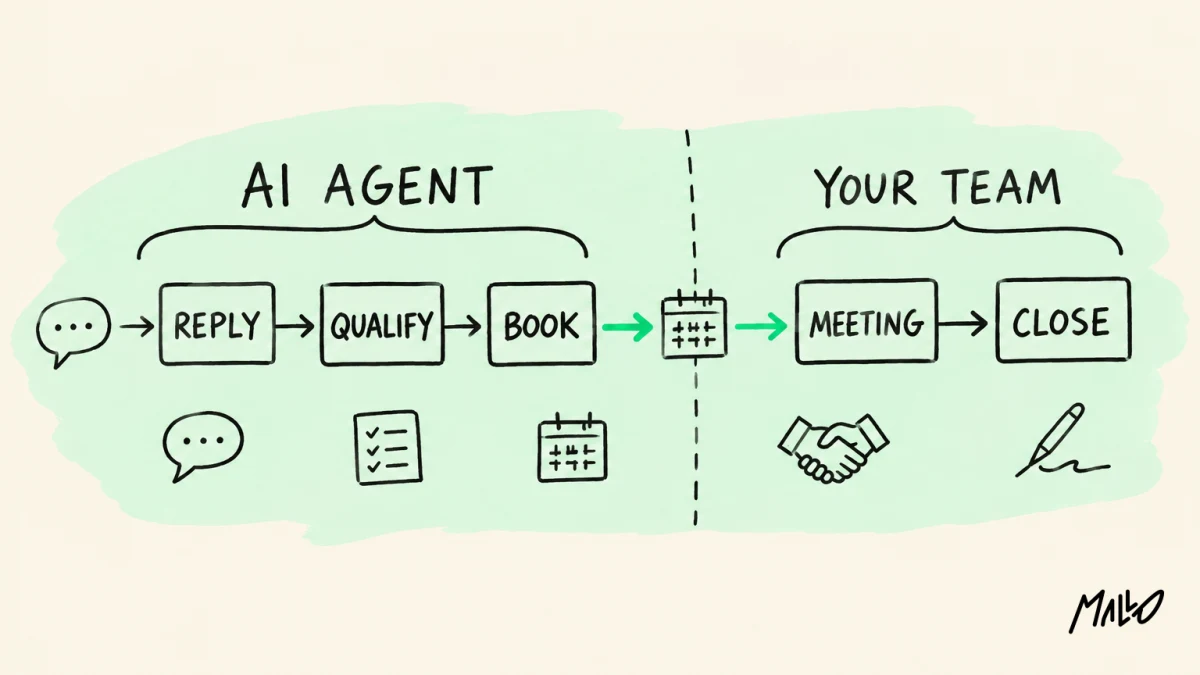
The meeting, the negotiation and the signature belong to your sales team. An AI setter prepares them with a qualified lead and a summary of everything the lead said; it does not replace the conversation that wins the deal.
The hybrid model: an AI setter first, humans on the close
The model most sales teams adopt is simple: the AI setter takes every inbound lead from the first second, and humans take over once the meeting is booked.
How to split the work in your situation
- If you receive fewer than 50 leads a month
Start with an AI setter and keep your salespeople on meetings.
A full salary is hard to justify on so few leads, while an AI setter replies to each one within a minute and books meetings straight into your calendar.
- If you already have a sales team of 2 to 5 people
Put the AI setter on first replies and follow-ups.
Your reps stop chasing silent leads and spend their days in meetings, with a summary of each lead in the CRM before every call.
- If your CRM is full of leads nobody called back
Let the AI setter reactivate them before you hire.
Old leads already know your business. An agent can restart those conversations with approved WhatsApp templates and book the ones whose project is still alive.
Mallo is a French platform that deploys AI agents on WhatsApp to qualify, follow up and track your leads, from first contact to booked meeting. The agent replies within a minute, books meetings in your closers’ calendars, sends reminders and follows up silent leads with the right timing, as described in our WhatsApp follow-up message templates. It can also call leads with an AI voice agent when your market prefers the phone.