
An automated follow-up sequence is what stands between a lead you paid for and a lead you forgot. Without one, follow-ups depend on a busy salesperson remembering who to chase and when; with a bad one, every lead receives the same five messages, whatever they answered.
Most guides to follow-up sequences are written for cold email to people who never asked to hear from you. This one is for inbound leads, people who filled in a form, called or messaged you, and it covers what those guides skip: messages that adapt to the reply, leads who never pick up the phone, and the moment a human takes over.
What should an automated follow-up sequence handle, and what stays human?
Automate the timing and the repetition; keep the judgment. The sequence makes sure every lead gets the right message at the right moment, and your salesperson steps in when a conversation is worth a call.
- Automate: the first reply, the follow-ups at set intervals, the reminders, the closing message, and the logging of every reply in the CRM.
- Keep human: the meeting, the negotiation, complaints, and any lead who asks to speak to someone.
A good sequence stops talking the moment the lead starts.
Why do leads get lost between two follow-ups?
Leads rarely say no. They get lost in the gaps: the first reply that came too late, the call nobody answered and nobody followed up, the “call me in March” that nobody wrote down.
Timing is the first leak. A Harvard Business Review study of 2,241 US companies found that firms contacting a lead within an hour were nearly seven times as likely to qualify it as firms that waited even one hour longer, and our page on speed to lead explains how to reply within a minute.
The second leak is the lead who never picks up. Two missed calls and the file goes cold, while a short message that can be answered in one word would have restarted the conversation. The third is the reply that changes the plan, such as “not before spring”, which a fixed sequence ignores.
How to build an automated follow-up sequence in 6 steps
Six steps turn a list of messages into a sequence that adapts to each lead. Write them down before you configure any tool.
Step 1: list the triggers
A trigger is the event that starts a sequence: a new form, a missed call, a quote sent, a meeting missed, a lead inactive for three months. Each trigger gets its own sequence, because a lead who never answered and a lead who went quiet after a quote do not need the same messages.
Step 2: choose the channel of each step
Use a message for the first reply and the follow-ups, the phone for leads who asked to be called, and email for documents. On WhatsApp, messages outside the 24-hour window must be templates approved by Meta, as our WhatsApp template guidelines explain.
Step 3: set the cadence and the number of steps
Default cadences by trigger
| Trigger | Cadence | Closing step |
|---|---|---|
| New inbound lead | Minute 1, hour 4, day 1, day 3, day 7 | Day 14 |
| Quote sent | Day 2 or 3, day 7, day 14 | Day 21 |
| Missed meeting | Within 2 hours, day 2 | Day 7 |
| Dormant lead | One message, then one reminder after a week | After the reminder |
Step 4: write messages that call for a reply
Every message should end with a question that takes one word or one number to answer. Our WhatsApp follow-up message templates give fifteen examples, from the first minute to a dormant lead.
Step 5: write the stop and handover rules
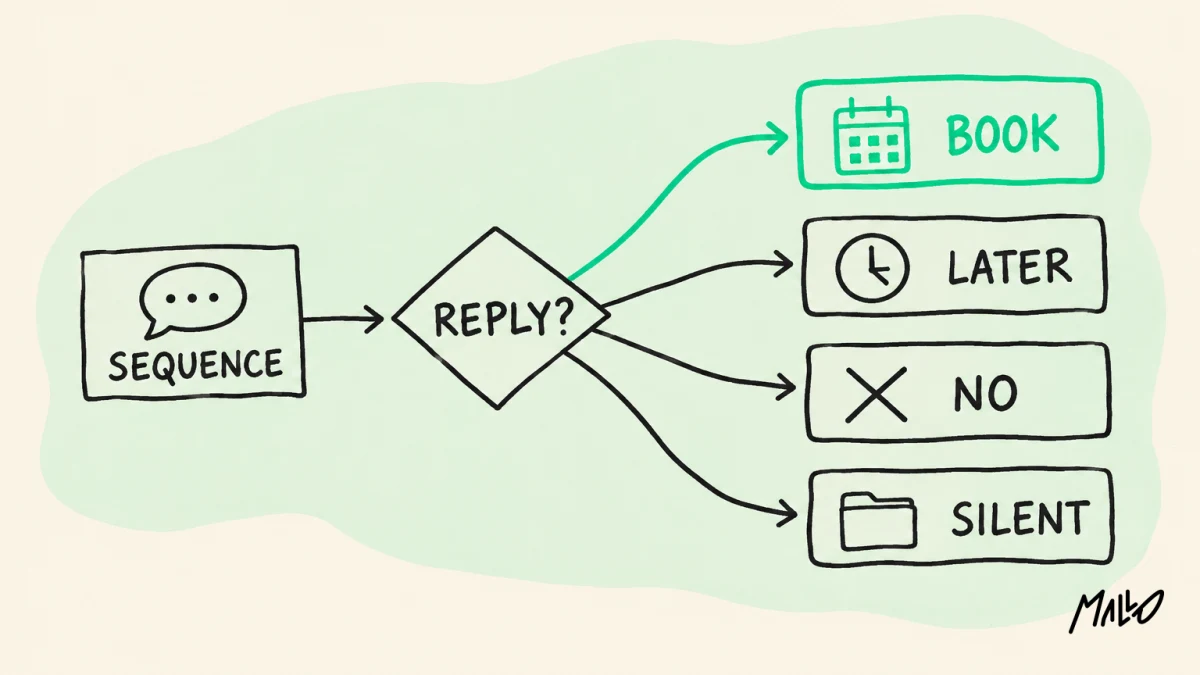
Decide what happens for each kind of reply: a booking ends the sequence and sends a reminder; “call me in March” pauses it until March; a no closes the file with a reason; a request to stop removes the lead; a complex question goes to a salesperson with the context.
Step 6: measure three numbers
Track the reply rate per step, the share of leads who book a meeting, and the time to first reply. A step that never gets replies should be rewritten or removed.
Which sequence for your situation?
- If you receive a steady flow of leads from ads or forms
Build the new-lead sequence first.
The first reply and the first three follow-ups recover the most leads, especially those arriving in the evening and at weekends.
- If you send quotes or book meetings that often go silent
Add the quote and missed-meeting sequences.
These leads already invested time with you. A short, timed sequence brings many of them back to a decision.
- If your CRM holds hundreds of leads nobody contacted for months
Run a reactivation sequence on that base.
One approved template and one reminder are enough to find the projects that are still alive, before you spend more on new leads.
4 messages for an automated follow-up sequence
These four messages cover the backbone of a new-lead sequence. Adapt the words in square brackets to your business.
Which tools can run an automated follow-up sequence?
Three families of tools can send follow-ups. They differ less in how they send messages than in what happens when the lead replies.
Three families of follow-up tools
| Family | Main channel | What is automated | When the lead replies |
|---|---|---|---|
| Email sequencers | Timed emails | The sequence stops; a human picks up the reply | |
| CRM workflows | Email, SMS, tasks | Messages and reminders for reps | A rep must read and answer |
| AI agents | WhatsApp, chat, voice | Messages, replies, booking and follow-up | The agent answers, qualifies and books |
Mallo is a French platform that deploys AI agents on WhatsApp to qualify, follow up and track your leads, from first contact to booked meeting. The agent runs each sequence on its trigger, reads every reply, follows the branch you defined, books the meeting in your sales team’s calendar and writes everything to your CRM, which is what our AI lead follow-up page describes in practice.
Mallo comes with a free trial, then pricing depends on your lead volume and the steps the agent handles.
Which mistakes make a follow-up sequence fail?
Most sequences that fail make one of these mistakes, and each one is quick to fix.
- Ignoring the reply: sending the day 7 message to a lead who answered “call me in March” tells them nobody reads their messages.
- Sending the same sequence to everyone: a new lead, a silent quote and a dormant contact need different triggers and cadences.
- Following up without consent: in the US, automated calls and texts fall under the TCPA, and on WhatsApp templates require opt-in.
- Never closing: a sequence without a final step keeps chasing until the lead blocks the number.
- Not logging replies: if answers stay in a phone, the next salesperson starts from zero.