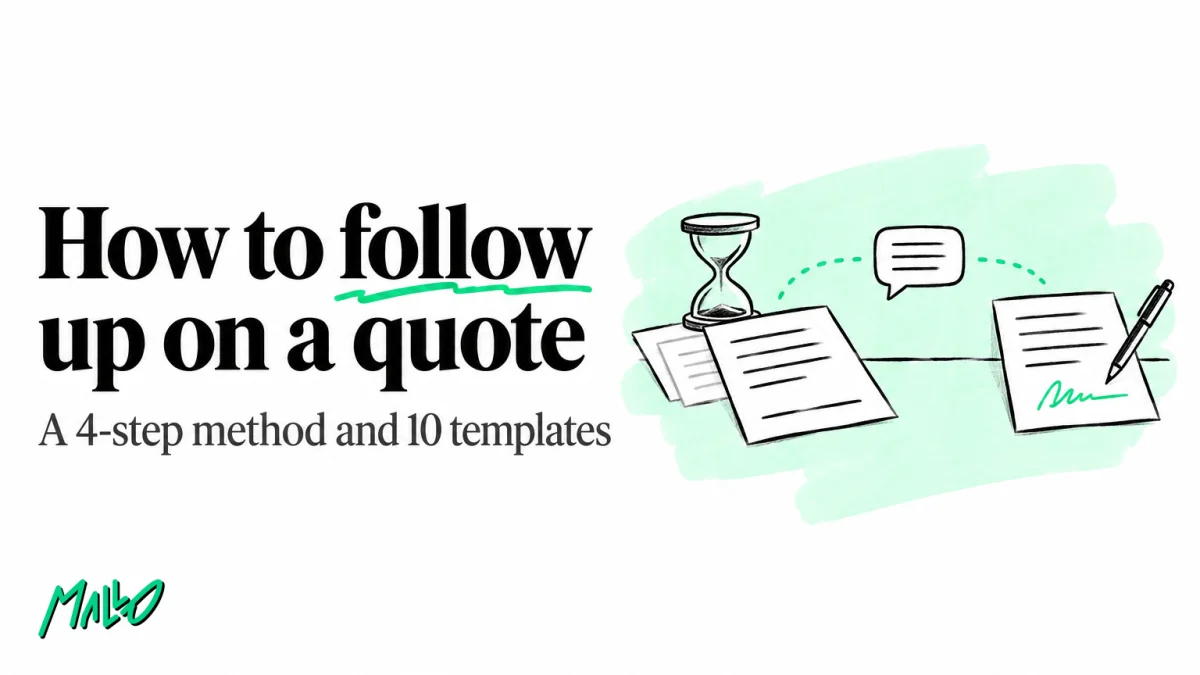
Knowing how to follow up on a quote is often worth more than winning one more lead. The work is done: you have met the customer, visited the site and priced the job. Yet many quotes end in silence, and the business moves on to the next lead without finding out why.
Most guides give you email templates and a schedule. This one starts by reading what the silence means, because the right follow-up for a customer comparing three quotes is not the right one for a customer waiting for their partner’s opinion. Then come the timing, a 4-step method and 10 templates, including WhatsApp.
Why does a quote go unanswered, and what does the silence mean?
A quote that goes unanswered is a decision that has stalled, not a decision that was made. The customer asked for a price, which means the need was real; something happened between the quote and the answer.
The five real reasons behind a silent quote
What the silence means, and the follow-up that unlocks it
| What is happening on the customer’s side | The visible signal | The follow-up angle that works |
|---|---|---|
| The project slipped in time | They mentioned “later this year” or a busy period | Ask whether the timing still holds, offer to hold a date |
| They are comparing several quotes | They asked detailed questions about scope | Help them compare fairly: what is included, what is not |
| Someone else has to decide | They said they would talk it over | Offer a short call with both decision makers |
| One line of the quote is blocking | Questions on one item, the total or the payment terms | Offer to adjust the scope rather than the price |
| The quote was never really read | No reaction at all after sending | Resend the essentials in three lines, in a channel they read |
The real cost of an abandoned quote
A quote represents hours of work: the first call, the site visit, the pricing and the write-up. Concretely, every quote dropped without a follow-up throws that time away, while a single message could have revealed a project that was simply waiting. In a solar or renovation business, where one signed quote pays for weeks of prospecting, a disciplined follow-up is one of the cheapest ways to grow.
When should you follow up on a quote?
Follow up 2 to 3 days after sending the quote, then space the next contacts over three weeks. Earlier feels like pressure; later, the customer has often moved on or signed elsewhere.
The first follow-up: 48 to 72 hours
Two or three days give the customer time to read the quote, and remain close enough to the visit for them to remember you. The goal of this first message is simple: check that the quote arrived and that nothing is unclear.
A cadence of four contacts over three weeks
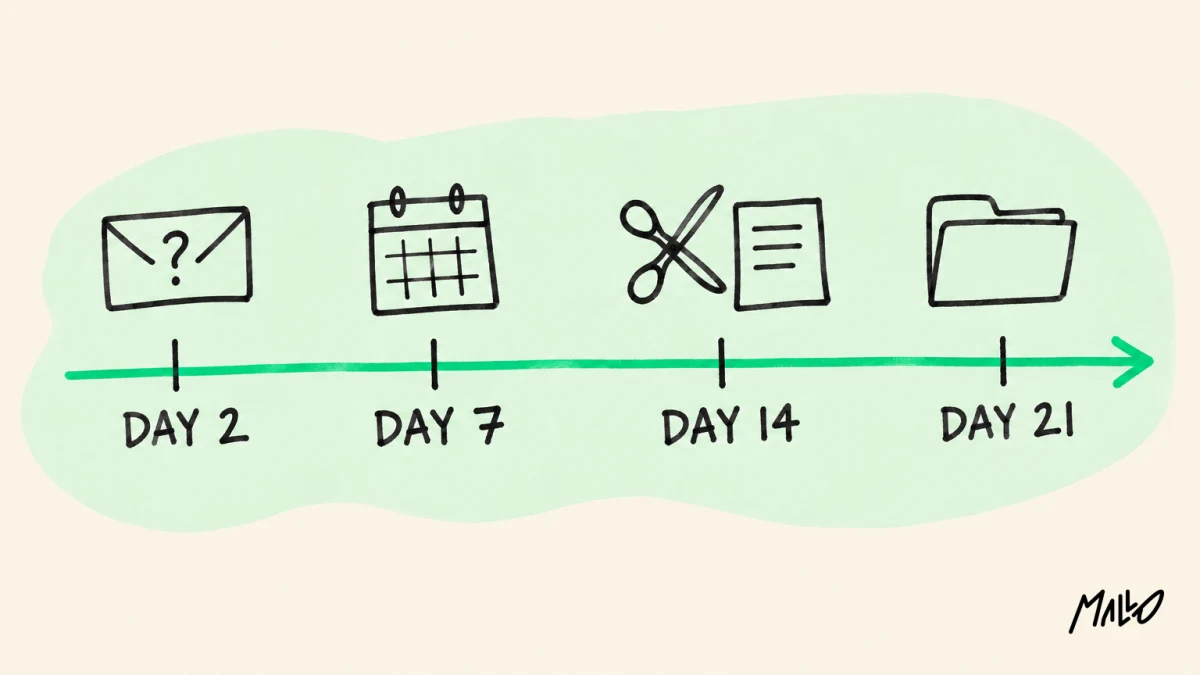
The quote follow-up sequence, contact by contact
| When | Goal of the message | Question asked |
|---|---|---|
| Day 2 or 3 | Check the quote arrived and is clear | Is there anything you would like me to explain? |
| Day 7 | Bring something useful | Does your timing still work with ours? |
| Day 14 | Open the discussion on scope | Would a different scope fit your budget better? |
| Day 21 | Close the file politely | Should I keep your quote on hold or close it? |
Adapt the cadence to your sales cycle
A small repair job is decided in days; a solar installation or a full renovation can take weeks, with financing and a partner involved. For long cycles, stretch the sequence and add a check-in at the date the customer gave you, rather than chasing every week.
How to follow up on a quote: a 4-step method
Every effective quote follow-up does four things. Apply them to any template below and the message stays short, polite and easy to answer.
Step 1: recall the context in one sentence
Name the project and the date: “the quote for your loft insulation sent on Thursday”. The customer may have received three quotes that week; yours should be recognizable in one line.
Step 2: ask a closed question, not for news
“Any news?” asks the customer to write a report. “Does the start date in March still work for you?” can be answered with yes or no, and the answer tells you where the project stands.
Step 3: leave a way out
Offer an easy exit: “If the project is on hold, just tell me and I’ll stop following up.” It sounds counterintuitive, yet it often brings the honest answer a pushy message never gets.
Step 4: log every follow-up in a status
Record each contact and each answer in your CRM: sent, followed up, on hold until a date, lost with a reason. Without a status, quotes fall through the cracks between two salespeople. Our WhatsApp CRM integration shows how replies can be logged automatically.
10 templates to follow up on a quote with no reply
Replace the words in square brackets. The first four form the standard sequence; the next six fit specific situations.
The four messages of the standard sequence
Six templates for specific situations
Should you follow up on a quote by email, phone or WhatsApp?
Use each channel for what it does best: email to send the quote, the phone for complex questions, and a messaging app for the short follow-ups people actually answer.
Email, phone and WhatsApp for a quote follow-up
| Channel | What it does well | Its limit for a follow-up |
|---|---|---|
| Sends the full quote, keeps a written record | Buried among promotions, slow to get a reply | |
| Phone | Handles objections and complex questions live | Often unanswered, intrusive at the wrong time |
| WhatsApp or text | Read quickly, answered in a word, fits short questions | Needs the customer’s opt-in; WhatsApp needs approved templates outside the 24-hour window |
A quote follow-up email to copy
Why WhatsApp unlocks dormant quotes
A short WhatsApp message lands where the customer already answers family and friends, and a numbered question takes seconds to answer. Outside the 24-hour window, the follow-up must be an approved template, usually in the marketing category; our WhatsApp template guidelines explain the rules, including the current block on marketing templates to US numbers.
Which mistakes bury a quote follow-up?
Most quote follow-ups fail for one of five reasons, and each one is easy to fix.
- Following up with nothing new: three “just checking in” messages tell the customer you have nothing to add.
- Cutting the price before understanding the block: a discount answers an objection the customer may not have, and costs you margin.
- Giving up after two messages: many decisions take weeks; a clear sequence with a polite close beats two messages and silence.
- Following up everyone the same way: a customer comparing quotes and a customer waiting for a partner need different messages.
- Not recording the no: a lost quote without a reason teaches you nothing about your pricing or your offer.
A quote follow-up should ask one closed question, never “any news?”.
How do you automate quote follow-ups without losing the human touch?
The sequence, the timing and the first answers are repetitive and easy to forget; the negotiation and the final decision are not. Automate the first part, keep your salesperson on the second.
Mallo is a French platform that deploys AI agents on WhatsApp to qualify, follow up and track your leads, from first contact to booked meeting. For quotes, the agent sends each follow-up on time with approved templates, understands the reply (“we’re comparing”, “my partner wants to see it”, “too expensive”), answers simple questions and books a call with your salesperson when the customer is ready.
Every answer is written to your CRM with a status and a summary, so no quote is left without a next step. It works the same way across industries, from solar installers with long sales cycles to services decided in a week, and it follows the logic of our AI lead follow-up page.
Mallo comes with a free trial, then pricing depends on your lead volume and the steps the agent handles.