
Referral automation is the most neglected growth lever in service businesses. Every installer, agent or coach knows that referred leads close faster, yet referral requests depend on a busy salesperson remembering to ask, at the right time, in the right words.
Most referral guides are written for online stores and software companies, with discount codes and dashboards. This one is for businesses that sell through conversations: it covers when to ask, how to ask by message, and how to make sure the referred person gets an answer within minutes, not days.
Why are referrals your most profitable acquisition channel?
Referrals bring customers who already trust you before the first call. A recommendation from a neighbor, a colleague or a friend does what no ad can do: it removes the doubt about whether you are reliable.
The value is measurable. A study by Schmitt, Skiera and Van den Bulte, published in the Journal of Marketing in 2011, found that referred customers were worth at least 16% more than comparable customers who joined at the same time without a referral, and Wharton’s summary of the study reports they were more likely to stay. Nielsen’s 2021 Trust in Advertising study found that 88% of people worldwide trust recommendations from people they know.
Why your happy customers do not refer you
Satisfied customers are willing to recommend you, but they rarely think of it on their own. Three things get in the way: nobody asks, the request comes weeks after the moment of satisfaction, or referring takes effort, such as finding your number or explaining what you do.
A referral is a request at the right moment, not a favor customers think of on their own.
What can you automate in a referral program, and what stays human?
Automate the timing, the reminders and the tracking; keep the relationship human. The goal is that no satisfied customer is forgotten, not that every word comes from a machine.
Manual vs automated referrals
| Criterion | Manual referrals | Automated referrals |
|---|---|---|
| Who asks | The salesperson, when they remember | A message triggered by a set event |
| Timing | Weeks after the sale, if ever | Right after the moment of satisfaction |
| Reminder | Rarely | One reminder a few days later |
| Referred lead | Waits for a callback | Gets a reply within a minute |
| Tracking and reward | Spreadsheet or memory | Recorded in the CRM, reward triggered on the agreed event |
Some parts stay human: a personal thank-you to your best customers, a call to a customer who replied with a complaint, and the meeting with the referred lead. An unhappy customer should never receive a referral request; the conversation should go to your team instead.
Mallo is a French platform that deploys AI agents on WhatsApp to qualify, follow up and track your leads, from first contact to booked meeting. After the sale, the same agent checks in with the customer, asks for a review, then for a referral, and replies to the referred person within a minute.
When should you ask a customer for a referral?
Ask right after a moment the customer is happy about, while the result is fresh. A referral request sent three months later competes with everything else in their life.
Events that should trigger a referral request
- Delivery of the result: the installation is running, the keys are handed over, the policy is active.
- A milestone reached: the first savings on the energy bill, a coaching goal achieved.
- A positive reply: the customer thanks you or says they are delighted.
- A positive review: the customer has just left a good review, the best moment to ask the next question.
Ask for a review before the referral
A review is a smaller ask than a referral, and it tells you who is happy enough to recommend you. Send the review request first, to every customer in the campaign, then ask for a referral a few days later. Our page on Google review requests shows how the agent handles that first step.
When to ask, by type of business
- If you install solar panels or heat pumps
Ask when the first bill shows the savings.
The installation is a big decision, and the first proof that it pays off is the moment customers talk about it to neighbors. Plan the request four to eight weeks after commissioning.
- If you are a coach or run a training program
Ask when the client reaches their first goal.
Clients refer you when they can describe a concrete result. Trigger the request on the milestone, not at the end of the contract.
- If you are a real estate agency
Ask a few days after the keys are handed over.
Buyers and sellers know people who are about to move. A request right after the move, when the stress is gone, gets the warmest answers.
The 5 building blocks of an automated referral program
Every automated referral program rests on five blocks. If one is missing, referrals leak: requests are forgotten, referred leads are not tracked, or rewards are never paid.
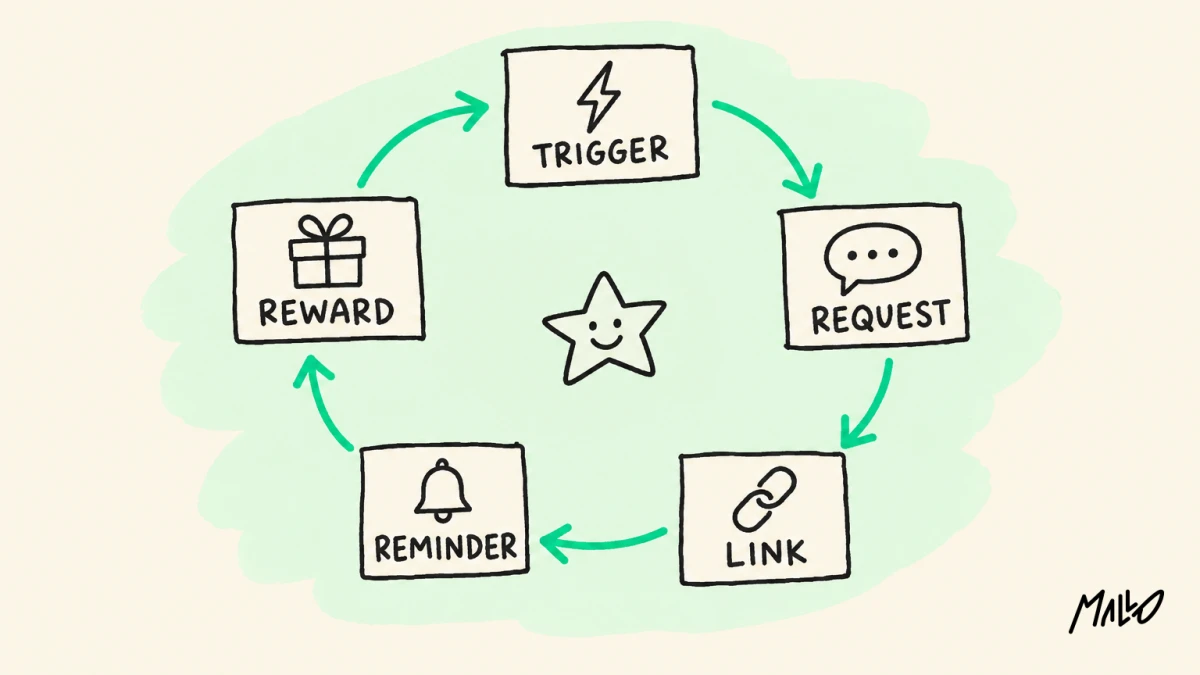
1. The trigger
Pick one event per business line, such as installation completed or goal reached, and record it in your CRM so the request goes out automatically.
2. The request message
Keep it short and personal: thank the customer, name the result, and make referring effortless, ideally a link that opens a WhatsApp conversation with your business.
3. The tracking link or code
Give each customer a unique link or code so you know who referred whom. A WhatsApp link with a pre-filled message, made with our free WhatsApp link generator, lets the referred person write to you first, which also settles consent.
4. The reminder
5. The reward and the attribution
Which referral reward to choose?
| Reward | Advantage | Limit | Best for |
|---|---|---|---|
| Cash or bank transfer | Simple and motivating | Feels transactional for some customers | High-value projects |
| Discount on a future service | Brings the referrer back | Useless if there is no next purchase | Maintenance, recurring services |
| Gift card or gift | Pleasant, easy to give | Logistics to manage | Most service businesses |
| Donation to a cause | Strong image, no awkwardness | Less motivating for some | Coaching, education |
What rules apply to referral requests and rewards?
Two sets of rules matter: consent for contacting the referred person, and disclosure when rewards meet public recommendations.
Let the referred person contact you first
The referred person did not ask to hear from you, so do not message or call them from a number the referrer handed over. The cleanest mechanism is a link the referrer shares, which the referred person uses to write to you; on WhatsApp, that opens the 24-hour window, and our WhatsApp template guidelines cover what you can send afterward.
Rewards and public recommendations
In the US, the FTC’s Endorsement Guides, revised in 2023, require that a material connection, such as a reward, be disclosed when someone recommends a business publicly. Never tie a reward to a positive review. In the UK, the advertising codes apply similar disclosure principles; check them before promoting a referral scheme publicly.
How to launch an automated referral program in 30 days
A referral program does not need months of preparation. Four weeks are enough to launch on a first group of customers and learn from it.
Week 1: define the program
Choose the trigger, the reward, the condition for paying it (meeting held, project signed) and who handles unhappy replies.
Week 2: write the messages
Write the review request, the referral request, the reminder, the first reply to the referred person and the thank-you. Submit the ones sent outside the 24-hour window as templates.
Week 3: connect the tools
Create the tracking links, connect the trigger to your CRM and make sure every referred lead is tagged with its referrer. Our WhatsApp CRM integration shows how replies land in HubSpot, Salesforce or your CRM.
Week 4: launch on a first group
Start with the customers whose project ended in the last two or three months, measure the replies, adjust the wording, then switch on the trigger for every new customer.
How do you measure and improve a referral program?
Four numbers tell you whether the program works, and where it leaks.
- Request rate: the share of eligible customers who actually received a request.
- Referral rate: the share of customers asked who referred at least one person.
- Referred lead conversion: the share of referred leads who booked a meeting, then signed.
- Time to first reply: how long a referred lead waited for your first answer.
Mistakes that kill a referral program
- Asking everyone at the same time instead of after each customer’s moment of satisfaction.
- Asking an unhappy customer, which turns a complaint into a public one.
- Making referring complicated, with forms and portals instead of a simple link.
- Leaving the referred lead waiting, which wastes the trust the referrer passed on.
- Paying rewards late, which ends the referrer’s goodwill for good.