
What is an appointment setter? In one sentence, it is the person between a new lead and a sales meeting. The role grew with online advertising: businesses suddenly had more leads than their salespeople could call back, and someone had to sort them and fill the calendar.
Most definitions stop at a job description. This guide also separates the setter from the SDR and the closer, explains how inbound setting on WhatsApp and social messages differs from cold calling, and shows which part of the job AI is taking over.
What does an appointment setter do day to day?
An appointment setter spends the day in conversations with new leads. The goal of each one is simple: decide whether the lead is worth a salesperson’s time, and if so, book the meeting.
- Reply to new leads from ads, forms, calls and messages, as fast as possible.
- Qualify with a short set of questions: the need, the timing, the budget, who decides.
- Book the meeting in the right salesperson’s calendar, with a summary of the conversation.
- Confirm and remind the lead before the meeting to reduce no-shows.
- Follow up leads who did not answer, missed a meeting or asked to be contacted later.
- Log everything in the CRM so the closer knows the context.
A setter’s job is not to make calls; it is to fill the calendar with meetings that happen.
Appointment setter vs SDR vs closer: what is the difference?
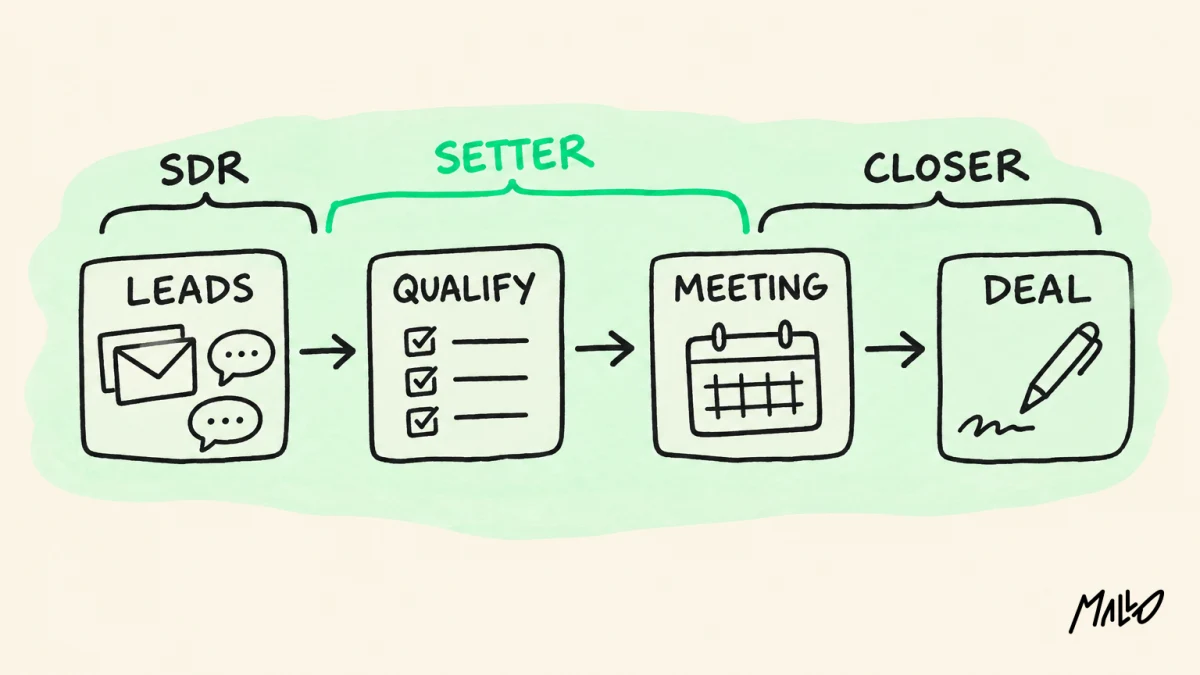
The three roles sit at different points of the same sales process. Confusing them leads to the wrong hire or the wrong targets.
Setter, SDR and closer compared
| Role | Main job | Typical leads | Measured on |
|---|---|---|---|
| Appointment setter | Qualify and book meetings | Mostly inbound: ads, forms, messages, social media | Meetings held |
| SDR (sales development representative) | Find and open new accounts | Mostly outbound in B2B: cold email, calls, LinkedIn | Opportunities created |
| Closer | Run the meeting and sign the deal | Leads booked by the setter or SDR | Revenue signed |
In coaching and high-ticket offers, the setter and closer roles are often called “high-ticket setting”: a setter handles the direct messages after a launch, and a closer takes the sales calls. In service businesses such as solar, real estate or insurance, the setter books the site visit, the viewing or the advisory meeting.
Inbound setting vs cold calling: two different jobs
Appointment setting is often confused with telemarketing, but most setters today work on inbound leads, people who already raised their hand. That changes the job entirely.
Inbound setting
The lead filled in a form, sent a message or replied to an ad. The setter’s advantage is speed: replying while the lead is still interested, often on WhatsApp or in social media messages, where people answer quickly. Our page on speed to lead explains why the first minutes matter so much.
Outbound setting
The setter contacts people who never asked to hear from the business, by phone or email. Contact rates are lower, rules on consent are stricter, and the work looks more like an SDR’s prospecting than like inbound setting.
How are appointment setters measured and paid?
Good setters are measured on outcomes, not activity. Three numbers tell you whether the job is done well.
- Contact rate: the share of new leads the setter actually reaches.
- Qualification rate: the share of contacted leads who fit your criteria.
- Show-up rate: the share of booked meetings that actually happen.
Pay usually combines an hourly rate or salary with a commission per meeting held or per deal closed. Paying on meetings held, rather than meetings booked, keeps the incentive on quality. Our article on AI appointment setter vs human details US and UK pay data and the full cost per booked meeting.
What makes a good appointment setter?
The best setters combine speed, curiosity and discipline. They reply fast, ask questions rather than pitch, and never let a lead disappear without a next step.
- Speed: they answer new leads in minutes, not hours.
- Listening: they qualify by asking, and write down what the lead says in the lead’s own words.
- Discipline: they follow up on schedule and log every exchange.
- Honesty: they disqualify leads that are not a fit, instead of filling calendars with meetings that go nowhere.
How is AI changing appointment setting?
AI does not remove the setter’s job; it takes over the part that breaks first when volume grows. An AI appointment setter replies to every lead within a minute, at any hour, asks the same qualifying questions every time and books the meeting directly.
Mallo is a French platform that deploys AI agents on WhatsApp to qualify, follow up and track your leads, from first contact to booked meeting. The agent handles the first reply, qualification, booking, reminders and follow-ups, then hands the meeting to your closers with a summary. See how it works on our AI appointment setter page.
Human setters move toward the conversations that need judgment: high-value leads, complex questions and relationships with your best prospects. Mallo comes with a free trial, then pricing depends on your lead volume and the steps the agent handles.