
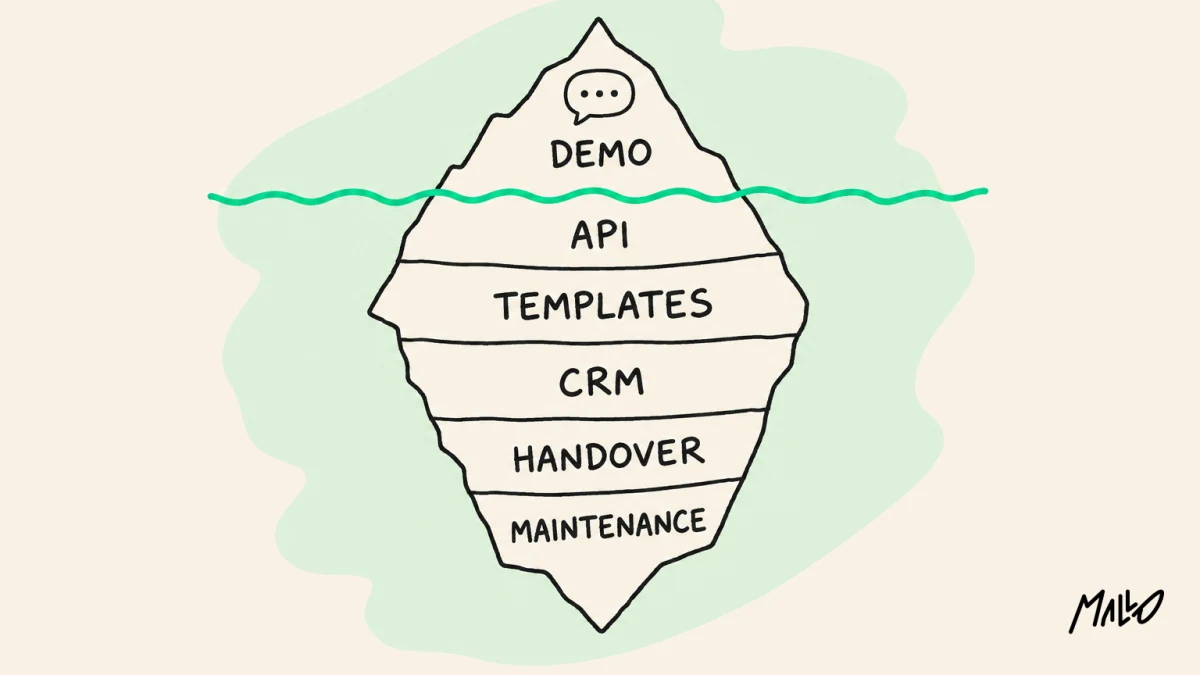
The build vs buy question for a WhatsApp AI agent usually starts with a demo: a few nodes in n8n, a call to a language model, and an agent that answers on WhatsApp in an afternoon. The question is what it takes to go from that demo to an agent that books meetings every day without breaking.
This comparison looks at three approaches through the costs that appear after the demo: the official API, templates, CRM sync, handover to humans, monitoring and maintenance.
Quick verdict: build or buy?
| Your situation | Recommended option | Why |
|---|---|---|
| You want booked meetings this month | Mallo | Live in minutes, with qualification, booking and follow-up |
| You have no developer to maintain an agent | Mallo | Meta, model and integration updates handled for you |
| You need HubSpot or Salesforce sync | Mallo | Native CRM sync with a summary of each lead |
What does it take to build a WhatsApp AI agent?
A working demo needs three pieces: a WhatsApp number, a language model and a script that connects them. A production agent for a sales team needs much more.
- The official WhatsApp Business API, a verified business profile and Meta-approved templates for the messages you send first.
- Conversation rules: your qualifying questions, your offer, what the agent must never say and when it hands over.
- Integrations: calendar booking, CRM sync with a summary, and lead sources such as ad forms.
- Operations: monitoring, error handling, opt-outs, logs, and updates when Meta, the model or your CRM changes.
Our WhatsApp template guidelines show how much of the work is about Meta’s rules rather than the AI itself.
What does each approach really cost?
Costs fall into three buckets: upfront build, monthly running costs and ongoing maintenance. A cheap start can hide an expensive year.
Build vs buy, cost by cost
| Cost | Agency custom build | DIY with n8n or Make | Mallo |
|---|---|---|---|
| Upfront | From a few thousand dollars for a proof of concept to tens of thousands for production, by agency estimates | Your team’s time: days to weeks | None: free trial, then a subscription |
| Time to live | Weeks to months | Days to weeks | Minutes |
| Running costs | Hosting, model usage and Meta fees | Server, model usage and Meta fees | Subscription based on your volume, plus Meta fees |
| Maintenance | New quotes for each change | Yours, every time something changes | Included |
One agency guide published in 2026 puts a proof of concept at $1,500 to $6,000 and a production agent at $25,000 to $75,000 over 8 to 12 weeks, with running costs of a few hundred dollars a month for 10,000 conversations, before any change requests.
The hidden work after the demo
Most custom projects slow down after the first demo, for the same reasons.
Templates and opt-in
Writing first to a lead from an ad form requires approved templates, the right category and recorded consent. Templates get rejected, recategorized or paused, and someone has to watch them.
Handover and edge cases
Real leads ask about prices, complain, send voice notes or write in another language. The agent needs rules for each case and a clean handover to a person, with the context.
CRM sync and reporting
Sales managers want every lead, answer and meeting in the CRM, with a status they can report on. Building and maintaining that sync is often more work than the conversation itself.
Keeping up with change
Meta changes pricing and policies, model providers release new versions, and your CRM updates its API. Each change is a task for whoever maintains the agent.
Why buying is the better choice for sales teams
Mallo is a French platform that deploys AI agents on WhatsApp to qualify, follow up and track your leads, from first contact to booked meeting. The agent is configured for your industry, your questions and your booking rules, runs on the official WhatsApp Business API and is live in minutes.
Everything that slows a custom project down comes ready: approved templates, opt-out handling, handover to your team with a summary, calendar booking, and sync with HubSpot, Salesforce, Zoho CRM, noCRM, Airtable, Google Sheets or the built-in CRM. The agent also follows up silent leads, reactivates old contacts and asks for reviews and referrals.
Teams that like to build keep control where it matters: Mallo’s open API and MCP connection let you query your leads from ChatGPT or Claude and connect your own tools. Mallo comes with a free trial, then pricing depends on your lead volume and the steps the agent handles.
Build or buy: which fits your situation?
The decision comes down to time, maintenance and what the agent must cover.
Build or buy for your situation?
- If you want meetings booked within weeks, not months
Choose Mallo.
The agent is live in minutes and starts qualifying and booking your leads straight away, without a development project.
- If you have a developer but not a full-time maintainer
Choose Mallo and use its API.
Your developer connects your own tools through the open API and MCP, while Meta, model and CRM updates are handled for you.
- If you already started a DIY agent that keeps breaking
Move it to Mallo.
Bring your qualifying questions and rules; the agent runs them on the official API with handover, CRM sync and follow-ups included.
The cost of an AI agent is not the demo; it is everything that keeps it booking meetings.
To compare ready-made platforms, see our ranking of the best WhatsApp AI agents.