
WhatsApp marketing and GDPR questions usually come up after the first campaign idea: can we message our leads, our old customers, the people who downloaded a guide? The answer depends less on WhatsApp itself than on who started the conversation and what each person agreed to.
This guide summarizes the rules in force in November 2026 in the UK and the EU, adds Meta’s own opt-in policy, and gives a sourced one-line summary for South Africa, Australia, India and the UAE. It is information for sales teams, not legal advice: check with your adviser before a large campaign.
Which rules apply to WhatsApp marketing?
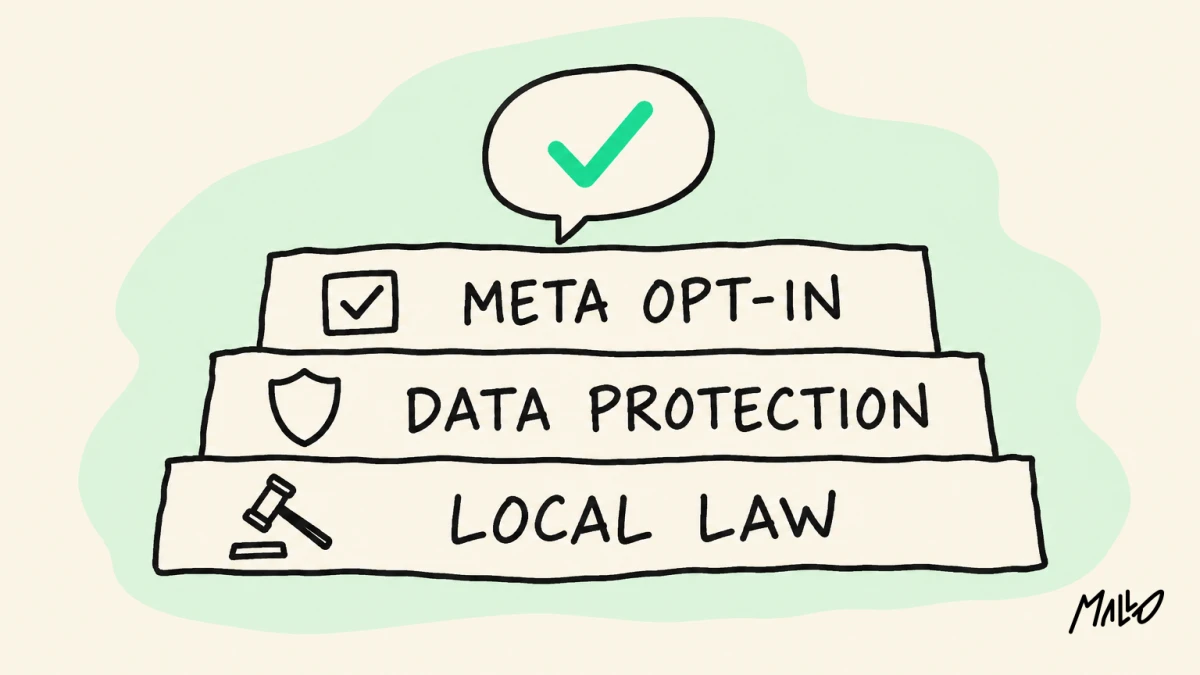
Two layers apply at the same time. The first is the law of the country where your contact lives: data protection law (GDPR in the EU, UK GDPR in the UK) and the rules on electronic marketing (PECR in the UK, national laws based on the ePrivacy Directive in the EU). The second is Meta’s WhatsApp Business policy, which applies everywhere.
Data protection law governs how you collect and use personal data, such as a phone number and a name. The electronic marketing rules govern when you may send a marketing message at all. Meta’s policy adds its own conditions on opt-in and opt-out, and Meta can restrict your number if you break them.
On WhatsApp, the first question is not what you say but who started the conversation.
What do UK rules allow? PECR and the soft opt-in
In the UK, the Privacy and Electronic Communications Regulations (PECR) set the rules for marketing by electronic mail, a definition that covers texts and direct messages. The ICO’s guidance on electronic mail marketing explains that marketing messages to individuals need their specific consent, unless the soft opt-in applies.
The soft opt-in, condition by condition
- You collected the contact details during a sale or the negotiation of a sale.
- You market your own similar products or services.
- You offered a way to refuse marketing when you collected the details.
- Every message offers a simple way to opt out.
The soft opt-in does not cover prospects who never bought or negotiated, or contacts from a bought list. For them, you need consent.
Solicited or unsolicited: who starts the conversation
The consent rule applies to unsolicited marketing. When a person writes to you first, from a Click-to-WhatsApp ad, a website button or a referral link, your reply to their request is not unsolicited, as the ICO’s guidance on identifying direct marketing explains. Messages you start later, to promote something new, are unsolicited again.
Is B2B WhatsApp marketing treated differently?
Partly. PECR’s consent rule for electronic marketing does not apply to messages sent to corporate subscribers, such as limited companies, according to the ICO’s business-to-business marketing guidance.
Two limits apply. Sole traders and some partnerships are treated as individuals, so the consent rule applies to them. And when you message a named person at a company, UK GDPR still applies: you need a lawful basis, must tell them how you use their data and must stop if they object.
What do EU rules allow?
In the EU, Article 13 of the ePrivacy Directive requires prior consent for unsolicited electronic marketing to individuals, with an exception for existing customers who receive offers for similar products and can object at any time. Each member state applies the directive in its own law, so details vary from country to country.
The GDPR applies on top: a lawful basis for processing, clear information at collection, the right to object to direct marketing, and data kept no longer than necessary. A lead who never replied two years ago is a weak basis for a new campaign, which is why our guide on how to reactivate old leads starts with cleaning and checking consent.
What does Meta require on top of the law?
Meta’s rules apply whatever the country. Its opt-in requirements say the person must clearly understand they are opting in to messages from your business, and that your business must be named; the opt-in does not have to mention WhatsApp specifically, and you must also comply with local law.
The WhatsApp Business Messaging Policy requires opt-in permission before you message people and respect for every request to block or stop. Outside the 24-hour window, only approved templates can be sent; our WhatsApp template guidelines cover categories and limits.
Is Meta your processor?
For the WhatsApp Business Platform, Meta’s business data processing terms describe WhatsApp as acting as your processor. Your business remains the controller of your contacts’ data and of the purposes you use it for.
What about other markets?
Outside the UK and the EU, the same logic applies: consent or an existing relationship, a clear sender and an easy opt-out. A one-line summary for four markets, to check with a local adviser:
WhatsApp marketing rules in other markets
| Market | Main law | Key rule for marketing messages |
|---|---|---|
| South Africa | POPIA, section 69 | Consent for unsolicited electronic marketing; existing customers can be messaged about similar products with an opt-out |
| Australia | Spam Act 2003 | Consent, sender identification and a working unsubscribe, as the ACMA explains |
| India | Digital Personal Data Protection Act 2023 | Consent-based processing, with the rules notified in November 2025 coming into force in phases |
| United Arab Emirates | Federal Decree-Law 45 of 2021 (PDPL) | Consent as the general basis and a right to object to direct marketing; free zones such as DIFC and ADGM have their own laws |
In Australia, the regulator’s page on avoiding spam sums up the three rules: consent, identify yourself, and let people unsubscribe.
How do you run compliant WhatsApp marketing in practice?
Compliance and results point in the same direction: messages people asked for get answered, and messages they did not ask for get blocked. Five habits cover most situations.
- Let people write first with Click-to-WhatsApp ads, website buttons and referral links, made with our free WhatsApp link generator.
- Collect clear opt-in in your forms, naming your business and the channel.
- Record consent with the date and source, alongside the contact in your CRM.
- Offer an opt-out in every marketing message and honor it immediately.
- Keep data only as long as needed, and review old contacts before any campaign.
Mallo is a French platform that deploys AI agents on WhatsApp to qualify, follow up and track your leads, from first contact to booked meeting. It runs on the official WhatsApp Business API, replies to people who write first within a minute, sends approved templates only to contacts who opted in, and records opt-outs in your CRM so nobody is contacted again. Mallo comes with a free trial, then pricing depends on your lead volume and the steps the agent handles.