
A WhatsApp sales funnel turns the app your customers already use every day into your sales pipeline. Instead of a form, an email and a callback three days later, the lead writes, gets an answer within a minute, and books a meeting in the same thread.
Most guides describe the funnel as a chatbot with buttons. Businesses that sell with a sales team need more: a conversation that understands free-form answers, books meetings, follows up the silent leads and keeps going after the sale. This guide maps that full cycle and shows where an AI agent takes over and where your team steps in.
What is a WhatsApp sales funnel?
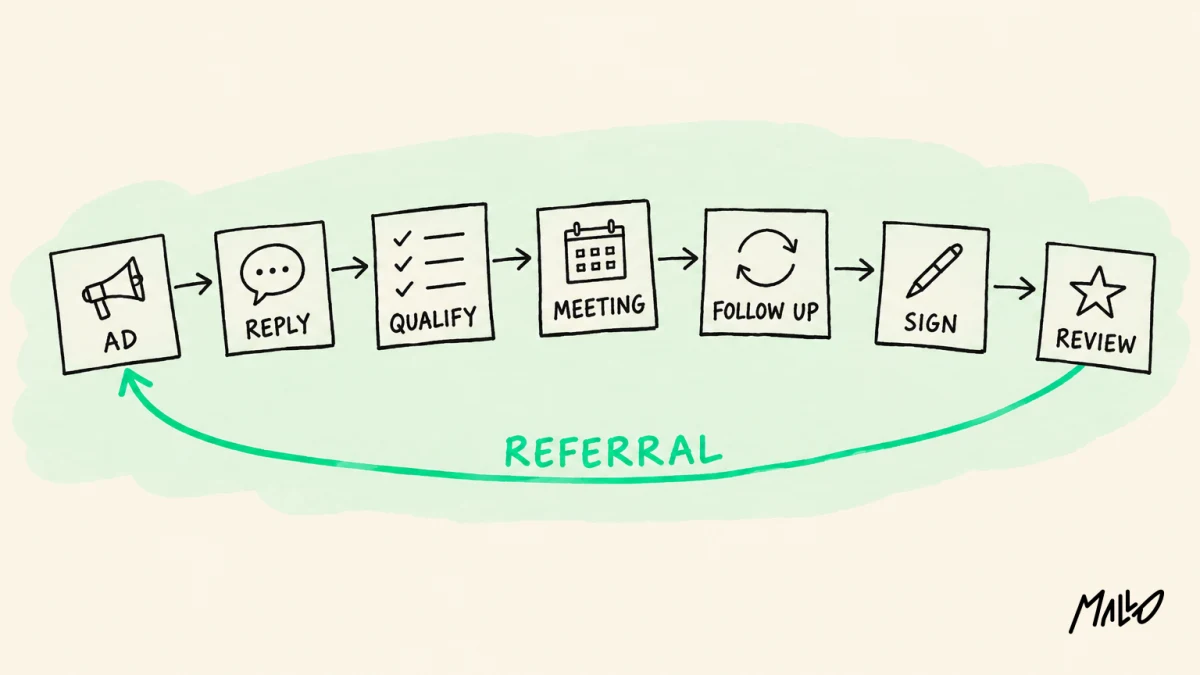
A WhatsApp sales funnel is the path a lead follows on WhatsApp, from the first message to the signature and beyond. Think of it as a shop counter that never closes: every visitor is greeted, asked what they need, and shown to the right person.
Who does what in an automated WhatsApp sales cycle
| Stage | What the AI agent does | What stays human |
|---|---|---|
| First message | Replies within a minute, day and night | Nothing |
| Qualification | Asks your questions, accepts free-form answers | Edge cases the agent hands over |
| Meeting | Books the slot, confirms, reminds the day before | The meeting itself |
| Follow-up | Chases silent leads and pending quotes | Negotiation |
| Reactivation | Restarts conversations with old leads | Nothing until a meeting is booked |
| Close | Sends documents and reminders | The signature |
| After the sale | Checks in, asks for a review, then a referral | Personal thank-yous, complaints |
The agent takes the volume and the timing; your team takes the meeting and the signature.
Why has WhatsApp become the channel of the sales cycle?
Because it is where leads answer. A phone call interrupts, an email waits behind promotions, while a WhatsApp message is read where people already talk to family and friends.
Response speed decides the sale
A lead compares offers the moment they ask for a quote. The first business to reply in a useful way usually gets the meeting, which is why the first minute matters more than the perfect pitch. Our page on speed to lead covers the research behind it.
Phone, email, SMS or WhatsApp for the sales cycle
| Channel | Reach | Two-way conversation | Fit for AI automation |
|---|---|---|---|
| Phone | Often unanswered | Yes, live | Voice agents, with consent rules |
| Slow, buried among promotions | Slow | Sequences, rarely a conversation | |
| SMS | Read quickly | Limited | Short reminders |
| Read quickly, answered in a word | Yes, rich (text, voice, documents) | Full conversation, booking, follow-up |
From the first message to the meeting: reply, qualify, book
The top of the funnel has one job: turn a new conversation into a qualified meeting before the lead cools down.
Reply within a minute, even on Sunday
Leads write in the evening and at weekends, when they finally have time. An AI agent replies within a minute at any hour, so the lead never waits for Monday morning.
Use the free window of Click-to-WhatsApp ads
When a lead messages you from a Click-to-WhatsApp ad and you reply within 24 hours, Meta opens a free entry point window that can stay open for up to 7 days, during which marketing, utility and service messages are free, according to Meta’s WhatsApp pricing documentation. Many guides still say 72 hours. A well-built funnel fits qualification, booking and reminders inside that window.
Qualify without an interrogation
Ask three to five questions, one at a time, in the order a good salesperson would: the need, the timing, the budget or decision maker. An AI agent understands free-form answers, so the lead can reply the way they talk.
Book, confirm, remind
The agent offers two slots, writes the meeting into the right salesperson’s calendar and sends a reminder the day before, with a one-tap answer to confirm or move it. No-shows drop when rescheduling is one message away.
Follow-ups and reactivation: recover the leads you already paid for
Most leads do not book on the first exchange. The middle of the funnel recovers them with a disciplined follow-up, instead of letting them disappear.
Follow up silent leads
A lead who stops answering gets a short follow-up at day 1, day 3, day 7 and a closing message around day 14, each ending with an easy question. Our WhatsApp follow-up message templates give the wording and the Meta rule for each step.
Follow up quotes and documents
Once a quote is sent, the funnel keeps going: a check on day 2 or 3, a useful update on day 7, an opening on scope on day 14. The method is detailed in our guide on how to follow up on a quote.
Reactivate your dormant CRM
Old leads already know you. A campaign of approved templates, followed by a real conversation with those who reply, turns part of that dormant base into meetings. See how database reactivation works with an agent.
After the sale: follow-up, reviews and referrals
The funnel does not stop at the signature. The months after the sale produce the cheapest new leads of all: reviews and referrals.
Keep the customer informed
Confirm the installation date, ask for a missing document, check in after the first week. These utility messages keep the customer confident and surface problems early.
Ask for a review at the right moment
Once the result is delivered, invite every customer in the campaign to leave a review; negative feedback goes to your team so you can fix the issue. Our page on Google review requests shows the flow.
Trigger referrals automatically
A few days after a positive review, ask for a referral with a simple link, and reply to the referred person within a minute. Our guide to referral automation covers the five building blocks.
What should AI not do in your sales cycle?
An AI agent is powerful because it follows rules. Writing down those rules, including what it must not do, is what keeps the funnel trustworthy.
The close stays human
Negotiation and signature belong to your sales team. The agent prepares them with a qualified lead and a summary of the conversation; it does not close deals.
Sensitive cases go to your team
A complaint, a legal question, a customer in difficulty or a request outside your offer should be handed over immediately, with the context, to the right person.
WhatsApp and privacy rules
Collect opt-in before sending templates, respect the 24-hour window, stop when a person asks you to, and handle personal data according to the law that applies to your customers, such as the GDPR in Europe.
How to build your WhatsApp sales funnel in 5 steps
Start small, measure, then extend. Five steps take you from a manual process to a funnel that runs on its own.
1. Map your current cycle
Write down every step from the first contact to the referral, who handles it today and how long it takes.
2. Measure the leaks
Find where leads drop: unanswered evening leads, no-shows, quotes without follow-up, customers never asked for a review.
3. Pick a first step and one metric
Automate the leakiest step first, usually the first reply or the follow-up, and track one number, such as meetings booked per 100 leads.
4. Write the line between agent and human
List what the agent handles, when it hands over, and what it must never do. This document becomes the agent’s rules.
5. Extend to the rest of the cycle
Once the first step works, add reminders, follow-ups, reactivation, then reviews and referrals, one at a time.
Where to start, by type of business
- If you are an installer or contractor with leads from ads
Start with the first reply and qualification.
Evening and weekend leads are the first to leak. An agent that replies within a minute and books the site visit recovers them immediately.
- If you run a sales team that already books many meetings
Start with reminders and quote follow-ups.
No-shows and silent quotes cost the most once meetings are flowing. Reminders and a quote sequence protect the pipeline you already have.
- If you are a coach or run programs after a launch
Start with the DMs and booked calls.
After a launch, messages pile up faster than anyone can answer. The agent qualifies each one and books the calls in your calendar.
Whatever your starting point, the goal is the same: no lead waits, no meeting is forgotten, no happy customer is left without a review or referral request. Our page for coaches shows what the full cycle looks like after a launch.
Build it yourself, use a setter tool, or a full platform?
There are three ways to automate a WhatsApp sales cycle. The right one depends on how many steps you want covered and who will maintain it.
Three ways to automate your WhatsApp sales cycle
| Approach | Steps covered | Setup | Maintenance | For whom |
|---|---|---|---|---|
| Do it yourself (Make or n8n with ChatGPT or Claude) | What you build | Weeks of building and testing | Yours, every time Meta or a tool changes | Teams with a technical profile |
| An AI setter tool | First reply, qualification, booking | Days | Low | Teams that only need meetings booked |
| A full-cycle platform | From the first reply to the referral | Minutes | Handled by the platform | Teams that want the whole cycle covered |
Mallo is a French platform that deploys AI agents on WhatsApp to qualify, follow up and track your leads, from first contact to booked meeting. One agent, set up for your industry, covers the full cycle described in this guide, writes every lead to your CRM through the WhatsApp CRM integration, and hands over to your team for the meeting and the signature.
Mallo comes with a free trial, then pricing depends on your lead volume and the steps the agent handles.